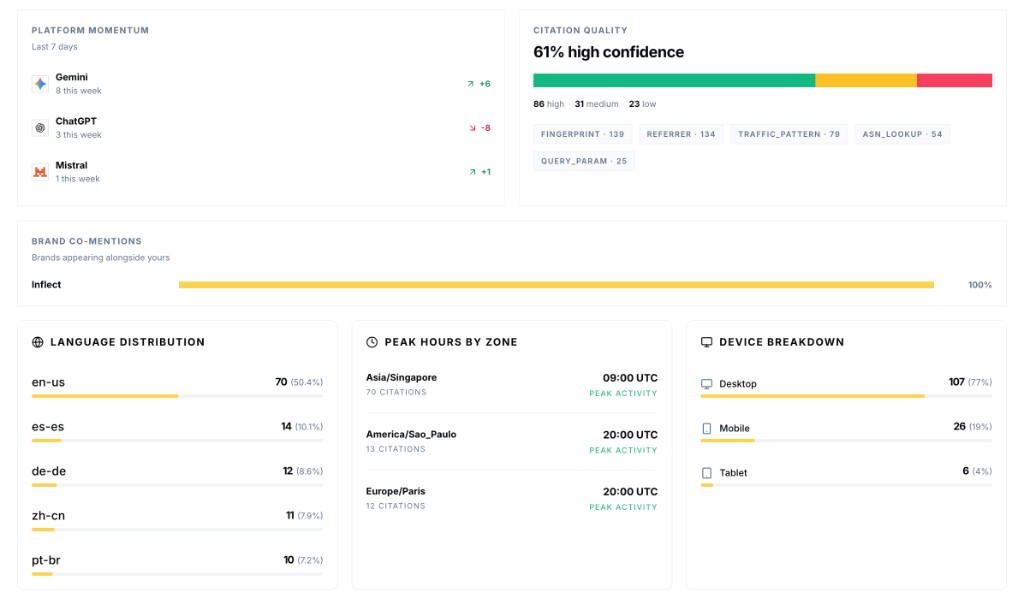
Quick Summary: Semrush and Inflect are both useful in AI search workflows, but they solve different problems. Semrush gives you stronger market and competitor context. Inflect gives you stronger page-level attribution on what changed and why.
Most teams evaluate these tools as if they are direct substitutes. In practice, they sit at different layers of the same operating stack. Semrush helps you map the terrain: who is gaining visibility, which topics are moving, and where demand appears to be shifting. Inflect helps you run and measure content decisions at URL level, so you can tell whether a specific change actually improved citation outcomes.
That distinction matters more now than it did a year ago. Click behavior is changing on informational queries, and directional visibility is no longer enough to guide content roadmaps by itself. Ahrefs' update on AI Overviews reports substantial CTR compression in informational SERPs, while Pew's browsing-data analysis shows how commonly users now encounter AI-generated summaries during ordinary search sessions.
Semrush vs Inflect: Which decision are you trying to make?
The cleanest comparison is by decision type, not feature checklist.
| Decision You Need To Make | Semrush | Inflect |
|---|---|---|
| Which categories are growing in AI-driven discovery? | ✓✓ | ✓ |
| Which competitors are gaining share of visibility? | ✓✓ | ✓ |
| Which exact page edit increased citation likelihood? | Not available | ✓✓ |
| Which optimization pattern should be repeated next sprint? | Not available | ✓✓ |
| How do we brief leadership on market direction? | ✓✓ | ✓ |
| How do we brief leadership on causal content outcomes? | ✓ | ✓✓ |
The key is not picking one universal winner. The key is matching tooling to the question your team keeps failing to answer.
Quick Scorecard (Buyer Lens)
| Evaluation Dimension | Semrush | Inflect | Why It Matters |
|---|---|---|---|
| AI visibility reporting (domain/prompt level) | 9/10 | 6/10 | Shows whether AI answers surface your brand at all |
| Custom prompt tracking in AI search | 8/10 | 6/10 | Helps monitor behavior change across prompt sets |
| AI competitor / prompt research workflows | 8/10 | 5/10 | Useful for planning which angles to test |
| Site readiness checks for AI discovery | 7/10 | 7/10 | Prevents obvious eligibility gaps before measuring impact |
| Page-level citation attribution by URL revision | 3/10 | 9/10 | Turns visibility into “which edit worked” decisions |
| Optimization -> citation/visit attribution loop | 2/10 | 10/10 | Creates a repeatable feedback loop for GEO/AEO |
These scores are not absolute product grades. They are fit scores for teams optimizing AI citation outcomes.
Where Semrush wins
Semrush is strongest when your priority is AI visibility monitoring. Their AI visibility toolkit is designed to generate AI visibility reports for domains, track sets of custom prompts, and help you benchmark how your brand appears across AI search experiences. For teams that need fast signal on whether “AI is mentioning us,” Semrush is often the quicker starting point.
Semrush also supports the planning layer: competitor and prompt research workflows help you decide which angles to build next. That makes it useful for content direction, not for attribution-level execution.
Where Semrush falls short for citation ops
Where Semrush is weaker is attribution granularity. Even when you have prompt tracking and AI visibility signals, you still cannot reliably answer: which exact URL revision caused a citation event, or which content change is most likely responsible for AI-origin visits. The workflow stops at visibility monitoring and does not provide the revision-level attribution loop that content teams need.
Where Inflect wins
Inflect is strongest when a team already publishes regularly and needs a reliable feedback loop. You optimize a specific URL, track what happens to that page, and connect outcomes back to a known revision path. That gives you a practical answer to the question teams actually care about: what should we keep, what should we roll back, and what should we scale?
In other words, Inflect turns "we got seen in AI" into "this page changed, then this happened." That shift from visibility narrative to decision evidence is what makes weekly iteration programs more predictable.
Where Inflect is not a full replacement
Inflect does not replace broad market intelligence. If your team lacks visibility into category movement or competitor trajectory, you still need a context layer for that. This is why many mature teams run a paired model: Semrush for market signal and Inflect for execution-level attribution.
Practical selection framework
Use this framework:
- Pick Semrush first if your immediate gap is market context and competitor monitoring.
- Pick Inflect first if your immediate gap is attribution confidence per URL.
- Use both if you need both macro awareness and sprint-level causality at the same time.
The fastest way to make a bad decision here is to buy for features. Buy for bottlenecks instead.
A buyer-side example
Consider two teams each shipping ten updates per month. Team A uses only market-level reporting. They can see movement, but they cannot isolate what created it, so planning decisions drift toward anecdotes. Team B pairs market signal with page-level attribution. They can point to a specific update on a specific URL, see a citation lift, and reuse that structure deliberately. Over six months, Team B usually compounds faster because its feedback loop is cleaner.
Internal linking and execution context
When implementing this strategy inside the Inflect workflow, anchor your tool selection to your operating model. Connect comparison decisions to your core operating principles in the Manifesto section. Align your execution with the conversion boundaries outlined on the Pricing page. Reference adjacent proof-oriented content on the Blog to maintain operational consistency.
Frequently Asked Questions
Is Semrush enough for AI visibility work? Semrush provides the necessary high-level visibility and competitive monitoring for broad market analysis. However, it does not provide the high-confidence page-level attribution required for granular content decisions. Teams need additional tools to track specific URL edits.
Is Inflect enough by itself? Inflect drives execution-level attribution workflows and proves causality at the page level. Teams needing macro intelligence still require a separate market research layer to understand broad category shifts. Operating both tools covers the entire decision stack.
Do we need both on day one? Teams do not need both platforms immediately. You evaluate your primary operational bottleneck to make the initial choice. Choose Semrush to solve market intelligence gaps, or choose Inflect to build attribution confidence.
What is the biggest mistake in this comparison? The primary error is treating the tools as identical alternatives. Buyers fail when they do not recognize Semrush and Inflect as distinct layers in the decision stack.
Ready to see where your domain shows up in AI search answers? Start with a free domain crawl →
Sources
- Ahrefs, "Update: AI Overviews Reduce Clicks by 58%"
- Pew Research Center, "What web browsing data tells us about how AI appears online"
- Semrush, "Investigating ChatGPT Search: Insights from 80 Million Clickstream Records"
- Vercel, "How we are adapting SEO for LLMs and AI search"
- Semrush, "AI Visibility Features"
- Semrush, "Prompt Tracking on Semrush"